DBA Hub

📋Steps in this guide1/12

Multitenant : Overview of Container Databases (CDB) and Pluggable Databases (PDB)

This article provides a basic overview of the multitenant option, with links to more detailed articles on the functionality.

oracle 12cconfigurationintermediate
by OracleDba
20 views
1

Creating Pluggable Databases (PDBs)

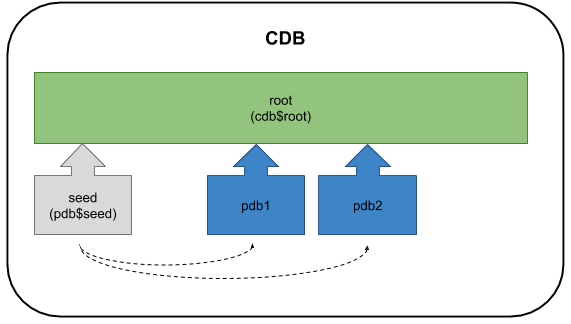
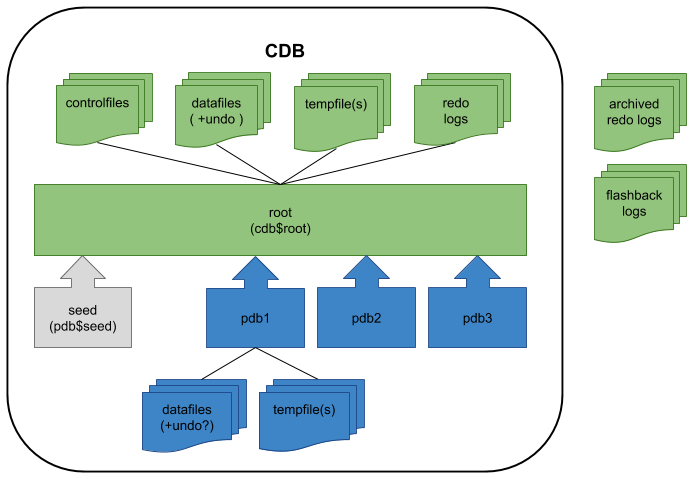
Oracle 12c Release 1 (12.1) introduced the Multitenant option. This article provides a basic overview of the multitenant option, with links to more detailed articles on the functionality. The multitenant option represents one of the biggest architectural changes in the history of the Oracle database. The option introduced the concepts of the Container Database (CDB) and Pluggable Database (PDB). - Container Database (CDB) : On the surface this seems very similar to a conventional Oracle database, as it contains most of the working parts you will be already familiar with (controlfiles, datafiles, undo, tempfiles, redo logs etc.). It also houses the data dictionary for those objects that are owned by the root container and those that are visible to all PDBs. - Pluggable Database (PDB) : Since the CDB contains most of the working parts for the database, the PDB only needs to contain information specific to itself. It does not need to worry about controlfiles, redo logs and undo etc. Instead it is just made up of datafiles and tempfiles to handle it's own objects. This includes it's own data dictionary, containing information about only those objects that are specific to the PDB. From Oracle 12.2 onward a PDB can, and should, have a local undo tablespace. This split of the data dictionary between common objects, in the root container, and PDB-specific objects, in the PDB's data dictionary, is very important, because this separation is what gives the multitenant option its flexibility. From the perspective of the PDB, the data dictionary is the union of the root and PDB data dictionaries, so internally the PDB feels very much like a normal Oracle database. For example, the and views within the PDB appears the same as any non-CDB database. Oracle recommend the use of Oracle Managed Files (OMF) when using the multitenant architecture, as it simplifies a number of pieces of functionality. It seems the use of OMF is mandatory for some functionality, like the Application Containers functionality in Oracle 12.2. Since the bulk of the working parts are already present in the root container, creating a new PDB is a comparatively quick and simple task. When creating a completely new PDP, the PDB is created as a copy of a seed PDB, so it only takes as long as the files take to copy.
Step 1
2

Creating Pluggable Databases (PDBs)

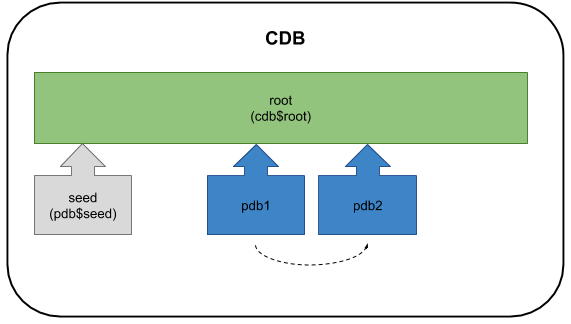
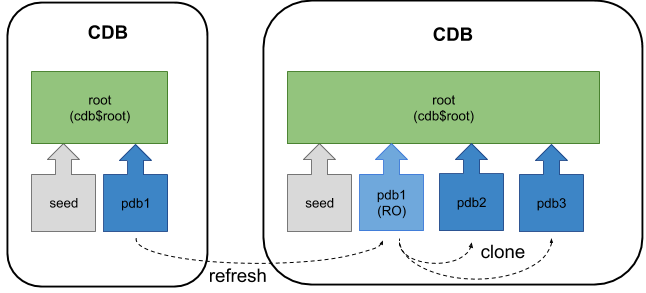
Instead of creating a new PDB from the seed, you can clone an existing PDB.
Step 2
3

Creating Pluggable Databases (PDBs)

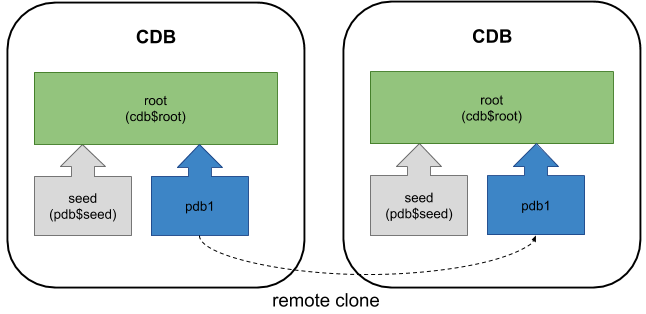
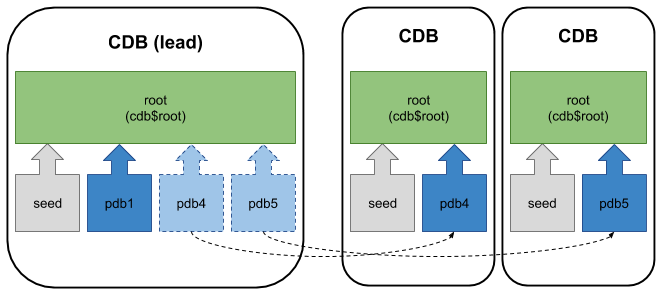
It is also possible to create clones in a remote CDB.
Step 3
4

Unpluging and Plugging in Pluggable Databases (PDBs)

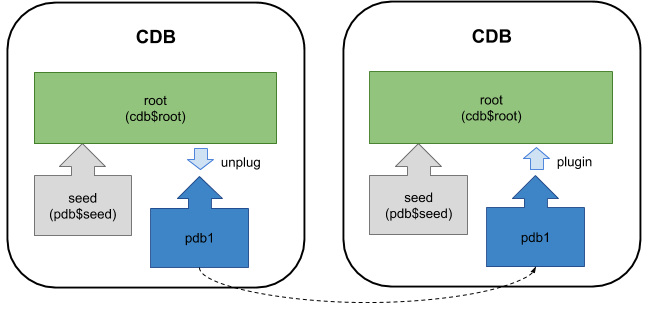
A more detailed description of creating and cloning PDBs can be found here . One of the most powerful features of the multitenant option is the ability to unplug a PDB from a CDB and plug it back into another CDB.
Step 4
5

Relocate a Pluggable Database (PDB)

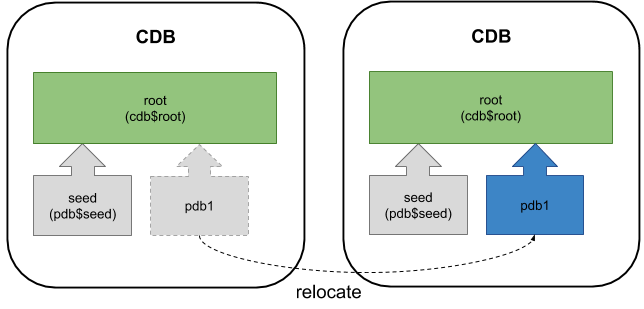
Not only does this allow databases to be moved easily, but it also provides an alternative way to patch and upgrade to future versions. An example of using unplug/plugin to perform a patch can be found here . A general discussion of the unplug/plugin mechanism is described here . Conversion of a non-CDB database to a pluggable database involves getting a description the non-CDB database and using this to plug it into a CDB as a new PDB. This method is described here . From Oracle 12.2 onward it is possible to relocate a PDB, moving it from one CDB to another. This is significantly simpler than doing a conventional unplug/plugin.
Step 5
6

Refreshable Pluggable Database (PDB)

You can read about the relocating PDBs here . From Oracle 12.2 onward it is possible to refresh a cloned PDB from the source PDB, provided it has only ever been opened in read-only mode.
Step 6
7

Refreshable Pluggable Database (PDB) Switchover

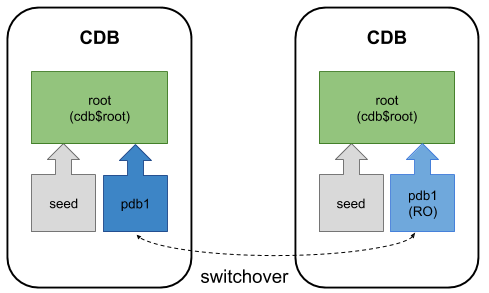
You can read about refreshing PDBs here . From Oracle 18c onward it is possible to switchover a refreshable PDB.
Step 7
8

Proxy Pluggable Database (PDB)

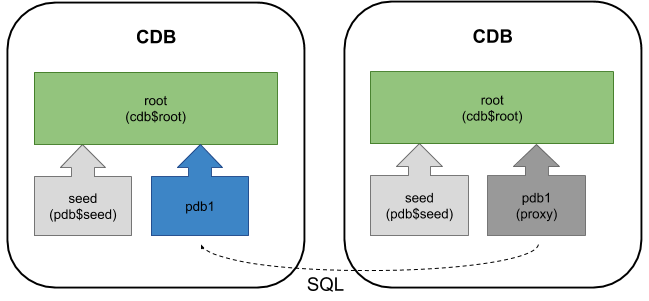
You can read about refreshable PDB switchover here . From Oracle 12.2 onward it is possible to create proxy PDB, which is a skeleton PDB that sends SQL across to a remote PDB to be processed. This allows you to have a local endpoint for a remote database.
Step 8
9

Application Containers

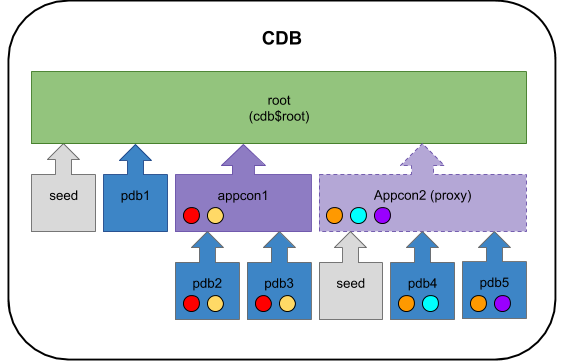
You can read about proxy PDBs here . Oracle 12.2 introduces the concept of application containers, which act like a mini-root container. They can be used to centralise shared configuration and applications, which are used by their dependent application PDBs.
Step 9
10

Pluggable Database (PDB) Snapshot Carousel

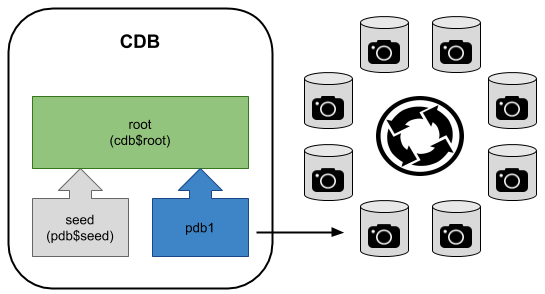
You can read about application containers here . From Oracle 18c onward it is possible to create automatically managed snapshots of a PDB, also know as a snapshot carousel.
Step 10
11

Container Database (CDB) Fleet Management

You can read about PDB Snapshot Carousel here . From Oracle 18c onward it is possible to monitor multiple container databases centrally as a fleet.
Step 11
12

Non-CDB Architecture Desupported

You can read about CDB Fleet Management here . The introduction of the multitenant option brings with it an extra layer of data dictionary views, allowing reporting across the root container and the pluggable databases (PDBs). Ignoring editions for the moment, prior releases had the following hierarchy. With Oracle 12c, an extra layer is added to the hierarchy. The views are described in the Reference Manual . * The output of the views is dependent on the container they are accessed from. When accessed from the root container, they do indeed present all the information from all the containers. When accessed from a PDB, they effectively act like the views from within the container. This can be a little confusing at first. The following articles provide more detailed explanations of some of the concepts described in this article. In 12.1 you can use a single PDB per CDB, also known as Lone-PDB, for free. If you want more than one PDB (2-252) you have to buy the Multitenant Option on top of Enterprise Edition. - Multitenant : Pluggable Databases - What they will break and why you should use them anyway! - Multitenant : Create and Configure a Container Database (CDB) - Multitenant : Create and Configure a Pluggable Database (PDB) - Multitenant : Prevent Accidental Creation of a Pluggable Database (PDB) - Lone-PDB - Multitenant : Migrate a Non-Container Database (CDB) to a Pluggable Database (PDB) - Multitenant : Connecting to Container Databases (CDB) and Pluggable Databases (PDB) - Multitenant : Startup and Shutdown Container Databases (CDB) and Pluggable Databases (PDB) - Multitenant : Configure Instance Parameters and Modify Container Databases (CDB) and Pluggable Databases (PDB) - Multitenant : Manage Tablespaces in a Container Database (CDB) and Pluggable Database (PDB) - Multitenant : Manage Users and Privileges For Container Databases (CDB) and Pluggable Databases (PDB) - Multitenant : Querying Container Data Objects (CONTAINER_DATA) - Multitenant : Backup and Recovery of a Container Database (CDB) and a Pluggable Database (PDB) - Multitenant : Flashback of a Container Database (CDB) - Multitenant : Resource Manager with Container Databases (CDB) and Pluggable Databases (PDB) - Multitenant : RMAN VALIDATE - Multitenant : Running Scripts in Container Databases (CDBs) and Pluggable Databases (PDBs) - Multitenant : Database Triggers on Pluggable Databases (PDBs) Multitenant : Remove APEX Installations from the CDB Multitenant : Transparent Data Encryption (TDE) in Pluggable Databases (PDBs) Multitenant : PDBs With Different Time Zones to the CDB Multitenant : Pluggable Database (PDB) Names Multitenant : Upgrade a PDB using Unplug/Plugin Recovery Manager (RMAN) Database Duplication Enhancements : Multitenant Considerations Upgrade the Database Time Zone File Using the DBMS_DST Package - Multitenant Running Commands in Different Schemas and Pluggable Databases - Multitenant : Remove APEX Installations from the CDB - Multitenant : Transparent Data Encryption (TDE) in Pluggable Databases (PDBs) - Multitenant : PDBs With Different Time Zones to the CDB - Multitenant : Pluggable Database (PDB) Names - Multitenant : Upgrade a PDB using Unplug/Plugin - Recovery Manager (RMAN) Database Duplication Enhancements : Multitenant Considerations - Upgrade the Database Time Zone File Using the DBMS_DST Package - Multitenant - Running Commands in Different Schemas and Pluggable Databases - Multitenant : Clone a Remote PDB or Non-CDB (12.1.0.2) - Multitenant : Controlling PDB Replication in Data Guard Environments : STANDBYS Clause (12.1.0.2) - Multitenant : Metadata Only PDB Clones (12.1.0.2) - Multitenant : PDB Subset Cloning (12.1.0.2) - Multitenant : PDB CONTAINERS Clause (12.1.0.2 and 12.2) - Multitenant : PDB Logging Clause (12.1.0.2) - Multitenant : USER_TABLESPACES Clause (12.1.0.2) - Multitenant : Rename a Pluggable Database (PDB) From 12.2 onward we are allowed to have a Proxy PDB, Application Root Container and a single user-defined PDB (regular or Application PDB) inside a single CDB without having to pay for the Multitenant Option. Notice we are still limited to a single user-defined PDB. The Multitenant Option still entitles you to 2-252 PDBs on regular kit, or 2-4096 PDBs on Oracle engineered systems or Oracle Database Clouds Services. - MAX_DATAPUMP_JOBS_PER_PDB Initialisation Parameter - Multitenant : Application Containers (12.2) - Multitenant : Controlling PDB Replication in Data Guard Environments : ENABLED_PDBS_ON_STANDBY Parameter (12.2) - Multitenant : Default Tablespace Clause During PDB Creation (12.2) - Multitenant : Disk I/O (IOPS, MBPS) Resource Management for PDBs (12.2) - Multitenant : Dynamic CPU Scaling - Resource Manager Control of CPU using CPU_COUNT and CPU_MIN_COUNT - Multitenant : Flashback Pluggable Database (PDB) (12.2) - Multitenant : Hot Clone a Remote PDB or Non-CDB (12.2) - Multitenant : Local Undo Mode (12.2) - Multitenant : Memory Resource Management for PDBs (12.2) - Multitenant : Parallel PDB Creation Clause (12.2) - Multitenant : PDB Archive Files for Unplug and Plugin (12.2) - Multitenant : PDB CONTAINERS Clause (12.1.0.2 and 12.2) - Multitenant : PDB Lockdown Profiles (12.2) - Multitenant : PDB OS Credentials (12.2) - Multitenant : PDBs With Different Character Sets to the CDB (12.2) - Multitenant : PDB Refresh (12.2) - Multitenant : PDB Upgrades Using Priority Lists, Inclusion Lists and Exclusion Lists (12.2) - Multitenant : Prevent Accidental Creation of a Pluggable Database (PDB) - Lone-PDB (12.2 Update MAX_PDBS) - Multitenant : Proxy PDB (12.2) - Multitenant : Relocate a PDB (12.2) - Multitenant : Rename Services During PDB Creation (12.2) - Multitenant : Resource Manager PDB Performance Profiles (12.2) - Multitenant : Specify a Service When Switching Between Containers (12.2) - Multitenant : Extended USER_TABLESPACES Clause (12.2) - Resource Manager : Per-Process PGA Limits (12.2) (PDB and non-CDB) - Heat Map, Information Lifecycle Management (ILM) and Automatic Data Optimization (ADO) - Service-Level Access Control Lists (ACLs) - Database Service Firewall Oracle 18c XE allows up to three user-defined PDBs for free. All other editions have the same rules as 12.2 regarding the Multitant Option. From 19c onward you are allowed to have 3 user-defined PDBs in a CDB without having to license the multitenant option, as described in the documentation here . - Hybrid Read-Only Mode for PDBs in Oracle Database 23ai - Hybrid Read-Only Mode for PDBs in Oracle Database 23ai - Oracle AI Database 26ai : Upgrade Overview - Multitenant : Unplug/Plugin PDB Upgrade to Oracle AI Database 26ai (AutoUpgrade) - Multitenant : Upgrade to Oracle AI Database 26ai (AutoUpgrade) - Upgrade Non-CDB to Oracle AI Database 26ai (Manual) - Replay Upgrade - Upgrade Non-CDB to Oracle AI Database 26ai (AutoUpgrade) - Multitenant : PDB Priority Settings in Oracle AI Database 26ai - Oracle REST Data Services (ORDS) : Database API - PDB Lifecyle Management - Multitenant Option: CDBs and PDBs - YouTube Playlist With the release of Oracle Database (12.1.0.2), the non-CDB architecture has been deprecated . Some 12c features do not currently work with the multitenant architecture ( see here ), so depending on the features you require, you may still need the old pre-12c style instances. Remember, using a single PDB does not require the Multitenant option, so lone-PDB setups can be used at no extra cost, allowing you to get familiar with the multitenant architecture. From 12.2 onward we are allowed to have a Proxy PDB, Application Root Container and a single user-defined PDB (regular or Application PDB) inside a single CDB without having to pay for the Multitenant Option. Notice we are still limited to a single user-defined PDB. At Oracle OpenWorld 2019 it was announced that the non-CDB architecture will be desupported from Oracle 20c onward. Oracle 21c is the first on-prem release that has the non-CDB architecture desupported. For more information see: - Introduction to the Multitenant Architecture - Overview of the Multitenant Architecture - Managing a Multitenant Environment Hope this helps. Regards Tim...
Step 12

Comments (0)

Please to add comments

No comments yet. Be the first to comment!